Etsuko leaves Japan
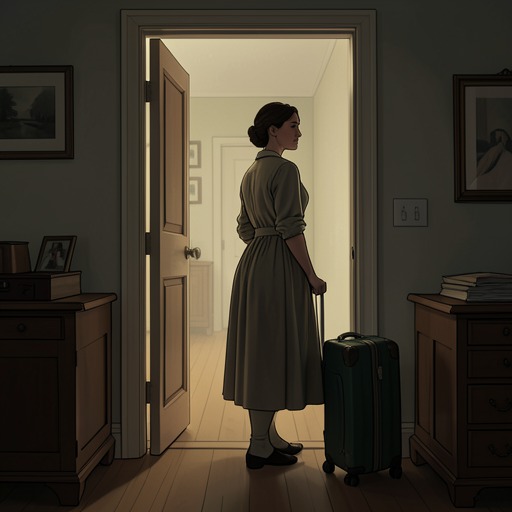
A Pale View of HillsEtsuko leaves Japan for England in a decision she later describes as justifiable and made with Keiko's interests at heart. The departure becomes more than a change of country: in conversation with Niki, it is also a disputed family history, shaped by what Etsuko chooses to remember, what she refuses to revisit, and the different accounts handed down by her and Jiro.
The decision in family memory
Niki tells Etsuko that she has spoken to a friend about how Etsuko and Jiro left Japan. The friend, Niki says, was impressed by the difficulty of the choice and understood that it had not been as easy as it might sound. Niki frames her mother's departure as an act of courage, contrasting women who leave unhappy marriages with those who remain trapped by children and unsatisfactory husbands. Etsuko does not welcome this reassurance. She considers Niki presumptuous, and notes that Niki has little idea what happened during those final days in Nagasaki.
Etsuko also doubts the version of the past Niki has assembled. She thinks Niki's picture must have been formed partly from what Jiro told her, and therefore contains inaccuracies. The departure is thus presented through a gap between generations: Niki treats it as an example of a woman finding the courage to act, while Etsuko insists that the circumstances were more complicated than that lesson allows.
Jiro and Keiko in the account of leaving
Etsuko resists the implication that leaving Japan requires her to cast Jiro as a villain. She says that, despite his articles about Japan, he never understood her culture; she also rejects the description of him as the oafish man her husband is said to have considered him. In her recollection, Jiro worked hard for the family and expected her to do her part. By his own standards, she says, he was a dutiful husband.
Her account also preserves his relationship with Keiko. For the seven years he knew his daughter, Etsuko says, Jiro was a good father. She never pretended that Keiko would not miss him. This qualification complicates any simple account of the move as escape from a bad marriage: Etsuko presents a decision she believed necessary while acknowledging the attachment and loss it entailed for her daughter.
Justification and refusal to reconsider
When Niki's praise makes Etsuko feel that she is being reassured about her own choices, Etsuko answers with marked curtness. She says her motives for leaving Japan were justifiable and that she always kept Keiko's interests very much at heart. Yet she immediately closes off further examination, insisting there is nothing to gain by going over the matter again. Her defense therefore asserts both a moral claim and a boundary: she will stand by the decision, but will not reopen the full account of how it came about.
That tension matters because Etsuko's insistence does not erase the unresolved costs. She acknowledges that Keiko would miss Jiro, while presenting her own motives as settled. The narrative offers her explanation without making it a complete or neutral record; her resistance to reconsideration sits alongside her admission that Niki's understanding is incomplete and that Jiro's account may have shaped it.
England as a remembered landscape
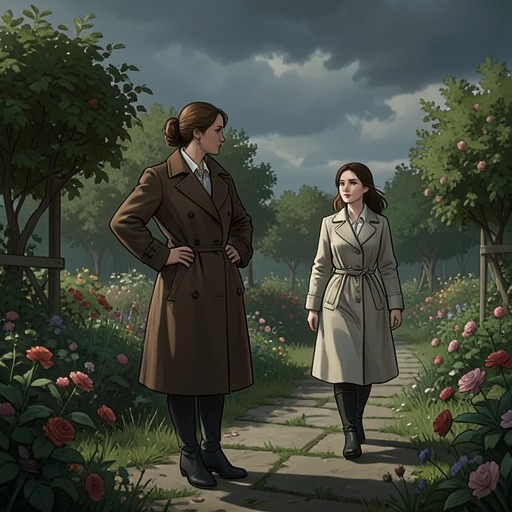
The later conversation takes place in England, where Niki and Etsuko walk by the orchard. Etsuko recalls that the trees were absent when they first came: the land had been fields, and the house could be seen from where she stood. When Jiro first brought her there, the fields and house looked as she had imagined England, and she remembers being pleased by that resemblance. The trees that have since grown across the landscape mark the passage of time between arrival and the present conversation.
This memory gives the departure a concrete setting without resolving its private motives. England first appears to Etsuko as an anticipated place made familiar by her imagination; years later, its changed landscape belongs to the life she has actually made there. The contrast between the fields she remembers and the orchard she now walks through echoes the distance between the decisive act of leaving and the retrospective accounts through which the family continues to understand it.